

International students arriving in Canada often budget carefully for tuition, housing, and food, but mobile phone plans remain a minefield of unexpected charges. According to Statistics Canada, international students contribute over $22 billion to the Canadian economy annually, yet many lose hundreds of dollars in their first months to avoidable mobile plan fees. The difference between cheap phone plans Canada students can rely on and those that drain your budget often comes down to understanding what carriers don’t advertise upfront.
Table of Contents
- Quick Takeaways
- Hidden Cost 1: Activation and SIM Card Fees That Add Up
- Hidden Cost 2: Data Overage Charges That Destroy Your Budget
- Hidden Cost 3: International Calling Traps
- Hidden Cost 4: Early Termination Penalties on Contract Plans
- Hidden Cost 5: Roaming Charges When You Travel Home
- Plan Type Comparison
- Frequently Asked Questions
- References
Quick Takeaways
| Key Insight | Explanation |
|---|---|
| Activation fees can cost $35-$50 | Traditional carriers charge setup fees that eSIM providers like PhoneBox eliminate entirely |
| Data overage charges run $5-$15 per GB | A single Netflix episode over your limit can cost $10-$20 in surprise charges |
| International calling adds $1-$3 per minute | A 30-minute call home costs $30-$90 without included international minutes |
| Contract cancellation fees reach $200-$400 | If you need to return home early, contract plans penalize you heavily |
| Roaming charges apply even within Canada | Some budget carriers charge extra when you travel between provinces |
| No contract mobile plans offer better flexibility | Month-to-month plans protect students from unpredictable schedule changes |
| eSIM activation is instant and free | You can activate service before landing in Canada, avoiding airport kiosk markups |
Hidden Cost 1: Activation and SIM Card Fees That Add Up
Most major Canadian carriers charge between $35 and $50 just to activate your account. This one-time fee appears on your first bill, often doubling what you expected to pay in your initial month. Fido typically charges $45, Koodo adds $40, and Freedom Mobile includes a $35 connection fee in most plans.
Physical SIM cards add another layer of cost. Traditional carriers charge $10-$15 for the plastic card itself, and if you damage or lose it, you’ll pay the same fee again for a replacement. In practice, international students who switch plans or carriers in their first semester often pay these fees twice or three times.
eSIM technology eliminates both charges completely. With providers that offer instant digital activation, you download your plan directly to your phone without any physical card or activation fee. PhoneBox provides eSIM activation at no charge, meaning you can switch plans or troubleshoot issues without paying repeated setup fees.
Pro tip: If you’re arriving in winter semester and might return home for summer, calculate the total cost including potential reactivation fees. A $40 monthly plan with $45 activation becomes effectively $47.50 per month over four months, making a $45 no-activation-fee plan cheaper overall.
The Airport Kiosk Markup
Airport mobile kiosks at Pearson, Trudeau, and Vancouver International charge premium prices, knowing you need service immediately. These retailers often add $20-$30 to standard plan prices and push more expensive options with higher commissions. A plan advertised as $35 online becomes $55 at the airport counter once activation fees and mandatory add-ons appear.
Activating an eSIM before you land solves this problem entirely. You can research cheap phone plans Canada students actually recommend, compare options without sales pressure, and have working service the moment your plane touches down.

Hidden Cost 2: Data Overage Charges That Destroy Your Budget
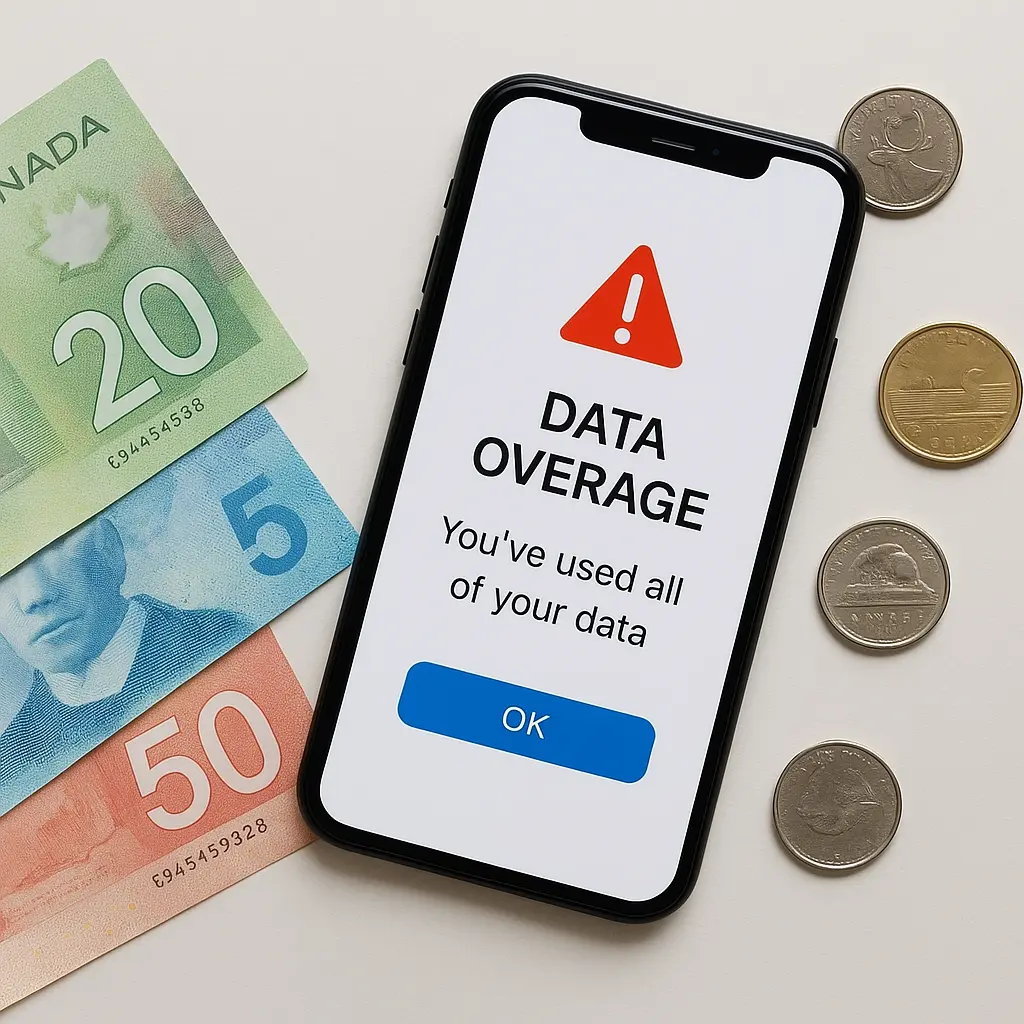
Canadian carriers handle excess data usage in three ways, and two of them will cost you significantly. Some automatically charge $5-$15 per additional gigabyte, others throttle your speed to unusable levels, and a few offer unlimited data with reduced speeds after your high-speed allotment.
The automatic overage model is where students get hurt most. You stream a lecture recording on your way home, download a presentation for class, or video call family during a stressful week. Before you realize it, you’ve used an extra 2-3 GB and face $30-$45 in surprise charges. A Statista report from 2023 showed Canadian mobile users paid an average of $57 per month, but those with overage charges paid $89.
The data consistently shows that students underestimate their usage in the first three months. You’re navigating new cities with Google Maps, using WhatsApp video calls more frequently than expected, and relying on mobile hotspot when your apartment internet has issues. What looked like enough data in your home country becomes insufficient under Canadian usage patterns.
“The single biggest complaint we receive from international students is unexpected data charges in their first billing cycle. Many come from countries with cheaper data and don’t realize how quickly video streaming consumes their allowance,” according to a 2023 Canadian Wireless Telecommunications Association consumer report.
How to Avoid Overage Traps
Choose plans with either true unlimited data or clear speed throttling instead of overage charges. PhoneBox offers plans with high-speed data that slows after your limit rather than charging extra, letting you control costs while maintaining basic connectivity. Set up usage alerts on your phone at 75% and 90% of your data limit.
Download offline maps, music, and course materials on WiFi before leaving home or campus. A 30-minute commute streaming Spotify uses approximately 150 MB, which adds up to 3 GB monthly just for music. Switching to downloaded playlists saves that entire allocation for essential uses.
Pro tip: Enable low data mode on iOS or data saver on Android immediately after activating your plan. This setting reduces background app refresh and automatic downloads, typically cutting usage by 20-30% without noticeably affecting your experience.
Hidden Cost 3: International Calling Traps
Calling home seems straightforward until you see your first bill. Standard rates for international calls from Canada range from $1 to $3 per minute depending on the destination country. A weekly 30-minute call to family costs $120-$360 per month at these rates, immediately making your cheap phone plan expensive.
Even plans that advertise “international calling” often include only 100-200 minutes to select countries. India, China, and many Latin American destinations fall under premium tiers with higher per-minute costs or aren’t included at all. The fine print matters significantly here.
Many international students assume they can use WhatsApp or WeChat for all calls, but in practice, you’ll need traditional voice minutes. Parents may not be comfortable with apps, time-sensitive matters require immediate voice contact, and some countries restrict VoIP services. You need a plan that includes meaningful international calling, not just an app-only strategy.
Comparing International Calling Options
PhoneBox includes international calling minutes to dozens of countries in standard plans, letting you call home without tracking every minute or fearing bill shock. Plans with included international minutes to your home country should be a primary selection criterion, not an optional add-on you consider later.
Calculate your actual calling needs realistically. If you call home twice weekly for 20 minutes each time, that’s 160 minutes monthly. A plan with 100 included minutes leaves you paying overage rates for 60 minutes, potentially adding $60-$180 to your bill. A plan with 500 included minutes costs slightly more upfront but eliminates surprise charges entirely.
Hidden Cost 4: Early Termination Penalties on Contract Plans
Two-year contracts with subsidized phones look attractive when you’re setting up your Canadian life. You get a flagship device for $0-$200 upfront instead of $1,000-$1,500. The carrier advertises this as saving you money, but the mathematics tell a different story for students with uncertain timelines.
Early termination fees start at $200 and scale up to $400-$600 depending on how much of your contract remains. If you need to return home for family reasons, decide to transfer universities, or find your program isn’t the right fit, you’re locked in. Even if you keep paying monthly without using Canadian service, you’ll pay $800-$1,200 over the remaining contract period.
A common mistake is underestimating how often plans change. Your study permit might not be renewed, you might secure an unexpected internship in another country, or family circumstances might require your return. Statistics Canada data shows approximately 15% of international students don’t complete their initially planned program duration.
The True Cost Calculation
Compare the total contract cost including device subsidy against buying an unlocked phone outright with no contract mobile plans. A $40 monthly plan with a $400 subsidized phone over 24 months costs $960 in payments plus the $400 device cost, totaling $1,360. A $45 no-contract plan over 24 months costs $1,080, and you can buy a quality unlocked phone for $300-$500, totaling $1,380-$1,580 but with complete flexibility to cancel anytime.
The flexibility premium is only $20-$220 over two years, or about $10 monthly. That’s negligible compared to the $400 early termination penalty you’d face if circumstances change. No contract mobile plans protect you from these penalties while providing essentially the same service quality.
Hidden Cost 5: Roaming Charges When You Travel Home
This hidden cost catches students during their first holiday break. You keep your Canadian SIM active while visiting home for winter or summer break, expecting minimal charges. Instead, you return to bills of $100-$300 because your phone connected to local networks and incurred roaming charges.
To avoid roaming charges Canada providers impose, you need to either fully disable mobile data and cellular service while abroad, port to a travel-friendly plan before leaving, or accept significant costs. Freedom Mobile customers face particularly high roaming fees outside their network coverage, which can include even traveling between provinces.
The data consistently shows students forget to disable roaming before their flight. Automatic app updates, email syncing, and message notifications all generate small data charges that compound quickly. A 2-week trip home with roaming enabled can easily cost $150-$200 if your phone pulls 500 MB to 1 GB of background data.
Strategies for Temporary Returns
If you’re leaving Canada for 2-4 weeks, put your plan on hold if your carrier offers that option, switch to the lowest available plan tier, or accept that you’ll pay for a month you don’t use. Koodo and Fido generally don’t offer true plan holds, meaning you pay full price even when you’re not in the country.
PhoneBox allows you to manage your plan through a self-serve app, making it simple to adjust your service level when you travel. Flexible monthly plans without contracts mean you can downgrade before leaving and upgrade when you return, paying only for the service you actually use.
Pro tip: If you’re keeping your Canadian number active while traveling, enable airplane mode and connect only through WiFi. Use WhatsApp or Skype for communication instead of allowing any cellular connection that might trigger roaming charges.
Plan Type Comparison
| Plan Feature | Traditional Contract Plans | No Contract eSIM Plans |
|---|---|---|
| Activation Fees | $35-$50 per activation | $0 with instant digital activation |
| Early Termination | $200-$600 penalty fees | Cancel anytime without penalty |
| SIM Card Costs | $10-$15 per physical card, replacement fees apply | Digital eSIM, no physical card needed, free reactivation |
| International Calling | Often costs $1-$3 per minute or limited included minutes | Included minutes to 20+ countries in standard plans |
| Data Overages | Automatic charges of $5-$15 per GB | Speed throttling instead of overage charges |
| Setup Timeline | Visit store, wait for card, 2-4 hours total | Activate before arrival, instant service |
| Plan Flexibility | Locked for 24 months, penalties for changes | Change monthly based on actual needs |
Frequently Asked Questions
What are the cheapest phone plans for international students in Canada?
The cheapest effective plans range from $35-$50 monthly and include unlimited talk and text with 10-20 GB of data. However, the true cost includes activation fees, potential overages, and flexibility penalties. PhoneBox offers plans starting at competitive rates with no activation fees, included international calling, and no contracts, making the total cost lower than advertised cheap plans from traditional carriers that add hidden fees.
How can I avoid roaming charges when traveling back home from Canada?
Enable airplane mode before your flight and connect only through WiFi networks while abroad. Alternatively, choose a carrier that allows easy plan suspension or downgrading through a mobile app. eSIM plans let you add a local data plan in your home country while keeping your Canadian number active for receiving messages through WiFi, avoiding roaming entirely without losing your Canadian contacts.
Are no contract mobile plans more expensive than contract plans?
Monthly rates are similar or sometimes $5-$10 higher, but total cost over time is usually lower. Contract plans hide costs in activation fees ($35-$50), early termination penalties ($200-$600), and inflexibility that forces you to pay for service you might not need. For international students whose timelines can change, the flexibility premium of $5-$10 monthly is worth avoiding a single $400 cancellation fee.
What happens if I go over my data limit on a student plan?
This depends entirely on your carrier’s policy. Some charge $5-$15 per additional gigabyte automatically, others throttle your speed to 512 kbps or lower, and some offer unlimited data with reduced speeds after your high-speed allotment. Always choose plans that throttle rather than charge overages. Throttled speeds still allow messaging, email, and maps, while overage charges can add $50-$100 to your bill unexpectedly.
Can I use eSIM with my current phone for a Canadian student plan?
Most phones from 2019 or newer support eSIM, including iPhone XR and later, Samsung Galaxy S20 and newer, and Google Pixel 3 and later. Check your phone’s settings under “Mobile Data” or “Cellular” for an option to add an eSIM or data plan. If you see these options, your phone is compatible. PhoneBox supports both eSIM and physical SIM cards, so you have options regardless of your device.
Do international students need to include international calling minutes in their Canadian plan?
While apps like WhatsApp and WeChat work for many calls, you’ll need traditional voice minutes for important situations. Banks, immigration offices, and universities often require voice calls that don’t work through apps. Family members may not be comfortable with app-based calling, and some countries restrict VoIP services. Plans with included international minutes to your home country cost only slightly more than basic plans but eliminate $100+ monthly charges for a few hours of calling home.
What’s the difference between cheap advertised plans and actual monthly costs?
Advertised prices typically exclude activation fees, taxes (13% in Ontario, 15% in Nova Scotia, 5% in Alberta), and overage charges. A $40 advertised plan costs $45-$46 after tax, plus $35-$50 activation in the first month, making your actual first bill $80-$96. If you exceed your data limit by 2 GB at $10 per GB, that month costs $65-$66 after tax. Calculate total costs including setup fees and realistic usage patterns, not just the advertised monthly rate.
Can I change my mobile plan if I find hidden costs too expensive?
With no contract mobile plans, yes. You can switch anytime without penalties, downgrade to a cheaper tier if you’re using less data than expected, or cancel completely if you’re leaving Canada. Contract plans typically lock you in for 24 months with $200-$600 early termination fees. For international students whose situations change frequently, contract-free flexibility is worth prioritizing even if the monthly rate is slightly higher.
Share your experience with hidden mobile plan costs in the comments below. Which surprise charges caught you off guard, and what strategies helped you save money on your student mobile plan?
References
- Statista telecommunications and mobile service pricing data
- Government of Canada official statistics and international student information
- Forbes consumer finance and mobile service cost analysis
- Statistics Canada economic and demographic research data