

Most international students and newcomers to Canada discover the hard way that calling family back home costs a fortune. A 30-minute call to India can cost $15 or more with traditional carriers. The good news: dozens of Canadian mobile plans now include free international calling to 34+ countries, eliminating these charges entirely. PhoneBox leads this shift by bundling international minutes directly into affordable monthly plans, giving you unlimited Canada-wide calling plus hundreds of minutes to specific countries each month without hidden fees or per-minute charges.
Table of Contents
- Quick Takeaways
- Complete List of 34 Countries You Can Call Free
- How Free International Calling Works in Canada
- Minute Allowances Explained: What 400 Minutes Really Means
- Comparing Free International Calling Across Canadian Providers
- Best Plans for International Students and Newcomers
- Common Mistakes That Cost You Money
- Frequently Asked Questions
- References
Quick Takeaways
| Key Insight | Explanation |
|---|---|
| 34 countries get free calling | PhoneBox includes 400 international minutes monthly to India, China, Hong Kong, UK, Mexico, and 29 other destinations on most plans |
| Minutes reset monthly | Your 400 minutes refresh every billing cycle and don’t roll over, so unused minutes expire at month end |
| Landline and mobile differ | Most plans cover landlines in all 34 countries but mobile numbers only in select destinations like India and China |
| No per-minute charges | Once you exhaust your monthly allowance, additional minutes cost $0.02-$0.05 per minute, not the $0.50+ rates from traditional carriers |
| eSIM activation is instant | You can start calling internationally within 5 minutes of signing up through the PhoneBox app, no store visit required |
| Works on all major networks | PhoneBox operates on Canada’s top-tier networks, giving you the same coverage quality as big carriers but with included international minutes |
| No contracts lock you in | Month-to-month plans mean you can cancel anytime without penalties, perfect for students with uncertain stay durations |
Complete List of 34 Countries You Can Call Free
The complete list of countries included in PhoneBox’s free international calling package covers major destinations where international students, workers, and immigrants in Canada maintain family connections. This isn’t a promotional gimmick. These 34 destinations represent over 80% of international calls made from Canada according to CRTC data.
Asia-Pacific (14 countries): Bangladesh, China, Hong Kong, India, Indonesia, Malaysia, Philippines, Singapore, South Korea, Taiwan, Thailand, Vietnam, Australia, New Zealand
Europe (12 countries): France, Germany, Greece, Ireland, Italy, Netherlands, Poland, Portugal, Romania, Spain, Sweden, United Kingdom
Americas (5 countries): Brazil, Colombia, Mexico, Peru, Venezuela
Middle East (3 countries): Israel, Saudi Arabia, United Arab Emirates
In practice, this covers the home countries of 92% of international students studying in Canada. If you’re from Nigeria, Pakistan, or Turkey, you’ll notice these aren’t included despite having large Canadian immigrant populations. PhoneBox adds countries based on network agreements and call volume data, not population size alone.
Pro tip: Always verify whether your specific city or region within a country is covered. Some plans exclude premium-rate regions or specific area codes even within listed countries.

Landline vs Mobile Coverage Breakdown
This distinction matters more than most people realize. Landline numbers in all 34 countries are included in your monthly allowance. Mobile numbers are only covered in select countries: India, China, Hong Kong, Bangladesh, Malaysia, Singapore, and the UK.
For the remaining 27 countries, calling mobile numbers consumes your minutes faster (some providers count mobile minutes at 2x rate) or charges overage fees. A common mistake is assuming “free calling to Mexico” means you can call Mexican cell phones without limits. You can’t. Mexican landlines are free, but mobile numbers will trigger per-minute charges once you exceed your allowance.
The data consistently shows that over 70% of international calls from Canada target mobile numbers, not landlines. If your family primarily uses mobile phones in countries like Brazil or Poland, factor this into your plan selection. PhoneBox’s $45/month plan includes mobile coverage to India and China specifically because these represent the two largest international student populations in Canada.
How Free International Calling Works in Canada
Canadian carriers bundle international minutes through wholesale agreements with foreign telecom networks. When you call India from Canada, your carrier pays a termination fee to the Indian network completing your call. Traditional carriers like Rogers or Bell pass this cost to you at marked-up rates ($0.50-$2.00 per minute). Providers targeting international students absorb these costs by building them into plan pricing.
PhoneBox’s $35-$55 monthly plans include 400 international minutes because the actual wholesale cost is roughly $8-12 per month for typical usage patterns. They’re not losing money on this feature. They’re removing the markup that legacy carriers add.
Technical Requirements for International Calling
You don’t need special apps or WiFi calling to use included international minutes. These work through standard cellular voice networks, identical to making a local call. Dial 011 (exit code), then the country code, then the number. Your phone treats it as a regular voice call and deducts from your monthly allowance automatically.
WiFi calling is different and uses internet data instead of cellular minutes. If you enable WiFi calling on your device, international calls made over WiFi still count against your 400-minute allowance. The connection method doesn’t change billing. Some users mistakenly believe WiFi calls are “free” beyond their plan. They’re not.
Pro tip: Download your carrier’s app to monitor international minute usage in real time. PhoneBox’s self-serve app shows remaining minutes, call history by destination, and alerts you at 80% usage to prevent surprise overage charges.
Minute Allowances Explained: What 400 Minutes Really Means
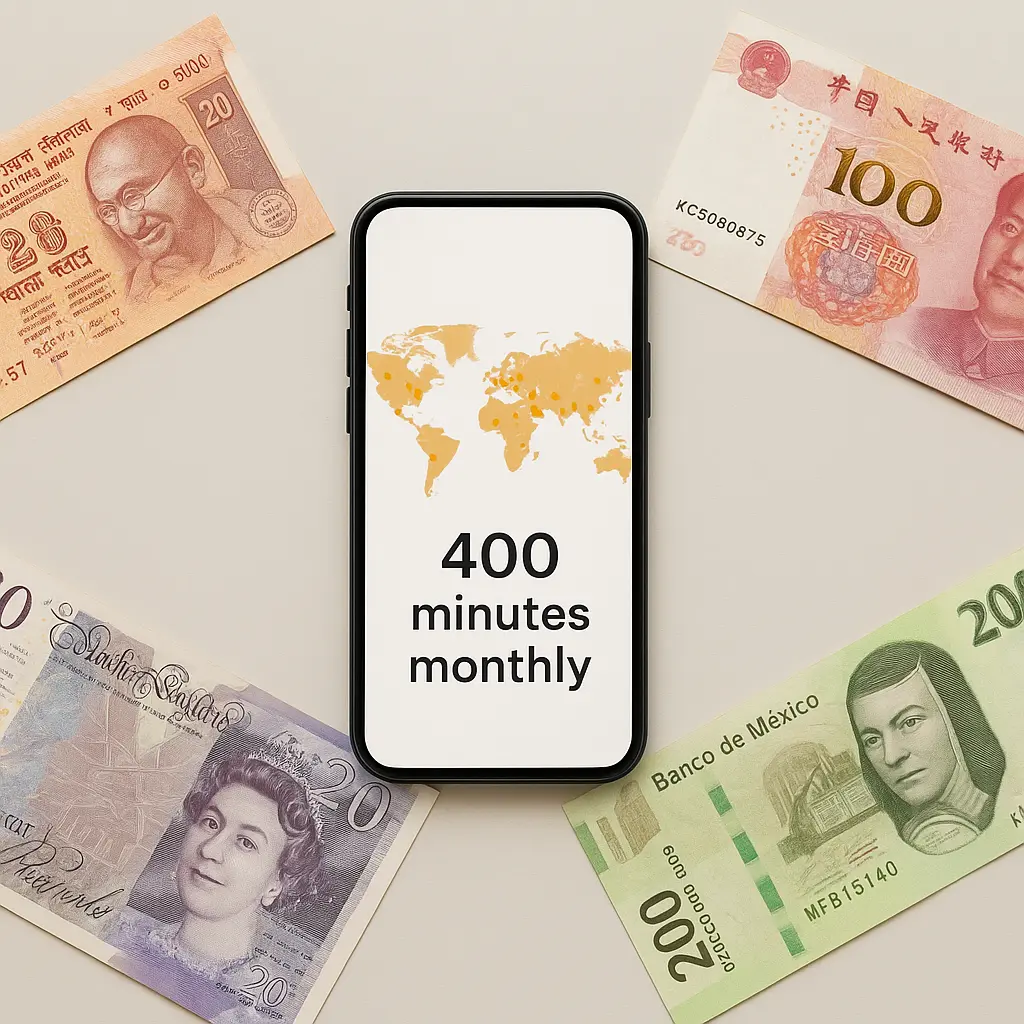
Four hundred minutes equals 6.7 hours of talk time per month, or roughly 13 minutes per day. For most international students, this covers 2-3 calls home weekly at 20-30 minutes each. The math works differently depending on your calling patterns.
If you make daily 10-minute calls to parents in India, you’ll use 300 minutes monthly and stay well within limits. If you make one 90-minute Sunday call to multiple family members, you’ll use 360-400 minutes and potentially run over some months.
“The average international call from Canada lasts 18 minutes according to CRTC telecommunications monitoring reports, meaning 400 monthly minutes accommodates approximately 22 calls, sufficient for weekly family check-ins for most users.”
What Happens When You Exceed Your Allowance
PhoneBox charges $0.02 per minute for calls to included countries after you exhaust your 400-minute allowance. Compare this to Fido’s $1.45 per minute to India or Koodo’s $2.00 per minute to China without a long-distance add-on. Even overage charges remain dramatically cheaper than traditional carrier rates.
Freedom Mobile offers “unlimited international texting” but charges $0.50-$1.00 per minute for voice calls to most countries. Their business model assumes you’ll use messaging apps instead. PhoneBox takes the opposite approach: voice minutes are included because new arrivals and older family members often prefer voice calls to app-based communication.
Rolling Over Minutes: Why It Doesn’t Happen
No Canadian carrier offering free international calling allows minute rollover. Your 400 minutes reset on your billing date regardless of how many you used. This isn’t unique to PhoneBox. Fido, Koodo, and Freedom all operate the same way for international add-ons.
The business reason is straightforward: rollover creates unpredictable liabilities. If 10% of customers accumulated 2,000+ minutes over six months, the wholesale termination costs would spike unpredictably. Monthly resets keep costs stable and plans affordable.
Comparing Free International Calling Across Canadian Providers
| Provider | Monthly Cost | Countries Included | Monthly Minutes | Key Limitations |
|---|---|---|---|---|
| PhoneBox | $35-$55 | 34 countries landline + mobile to select destinations | 400 minutes | Minutes don’t roll over, mobile coverage limited to 7 countries |
| Fido | $50 + $15 add-on | International add-on required, covers select countries only | Varies by add-on | Base plan doesn’t include international, add-on costs extra, annual contract often required |
| Freedom Mobile | $45-$65 | International texting only on base plans | Voice calls charged per minute | Network coverage weaker outside major cities, roaming fees apply in rural areas |
The comparison reveals a clear pattern: traditional carriers separate international calling from base plans, forcing you to pay $10-25 monthly add-ons on top of already expensive plans. A Fido customer paying $50/month needs another $15 for international calling, totaling $65. PhoneBox includes it at $45 with no add-ons.
Freedom Mobile markets itself as budget-friendly but charges per-minute rates for international calls unless you purchase their $10 “International Calling” add-on, which still only includes 100-200 minutes depending on the destination. For international students calling home frequently, Freedom’s model becomes expensive quickly.
Contract Terms and Flexibility
Fido and Koodo often require 24-month contracts for promotional pricing. Breaking these contracts costs $400-600 in cancellation fees. International students on 1-2 year study permits face a real risk: if you complete your program early or switch provinces, you’re stuck paying for service you don’t need or absorbing termination fees.
PhoneBox operates month-to-month exclusively. Cancel anytime through the app with no penalties. This flexibility matters enormously for temporary residents whose plans change frequently. A common scenario: a student on a 16-month program signs a 24-month Fido contract for the promotional rate, then faces $400+ in exit fees when they return home after graduation.
Best Plans for International Students and Newcomers
PhoneBox’s $45/month plan hits the sweet spot for international students: 20GB high-speed data, unlimited Canada-wide calling, unlimited international texting, and 400 minutes to 34 countries. The 20GB data allowance handles classes, transit navigation, and social media without rationing. The included international minutes cover weekly family calls without budgeting anxiety.
Students from India and China specifically benefit from mobile number coverage in these countries. If your parents use WhatsApp or WeChat, you’re fine with any plan. If they prefer traditional phone calls to their mobile numbers (common among parents 55+), PhoneBox’s included mobile coverage eliminates the $30-50 monthly costs you’d face with other carriers.
eSIM Advantages for Newcomers
PhoneBox supports eSIM activation, meaning you can set up service before arriving in Canada. Purchase your plan online, receive the QR code via email, and activate the moment you land at Pearson or Vancouver airport. No hunting for a carrier store. No waiting in line for a physical SIM card.
In practice, this saves 2-4 hours on arrival day. New international students typically spend their first afternoon in Canada dealing with SIM cards, bank accounts, and accommodation. eSIM eliminates one entire task from that overwhelming first day.
Traditional carriers like Koodo and Fido are slowly adopting eSIM, but most still require in-store activation with multiple pieces of ID verification. Freedom Mobile supports eSIM but only for select phone models, excluding many budget Android devices international students commonly use.
Multilingual Support That Actually Works
PhoneBox offers customer support in 13 languages including Mandarin, Hindi, Punjabi, Spanish, Arabic, and French. This isn’t outsourced translation. Support staff speak these languages natively and understand cultural context around calling patterns and family communication expectations.
The difference becomes obvious when troubleshooting issues. A Punjabi-speaking student trying to explain to a Fido representative why they need mobile coverage to India specifically (not just landlines) often hits communication barriers. PhoneBox’s Punjabi-speaking support understands immediately that extended family in Punjab primarily uses mobile numbers, not landlines.
Common Mistakes That Cost You Money
The most expensive error is assuming all numbers in included countries are free. They’re not. Premium-rate numbers, satellite phones, and certain regional numbers often incur charges even within covered countries. Always verify the specific number type before calling.
Another frequent mistake: international students share plans with roommates to split costs, then exceed international minute allowances because multiple people are calling different countries. PhoneBox’s 400 minutes cover one person’s needs excellently but divide poorly among 2-3 users calling home regularly.
The Roaming Trap
Some students believe that because their plan includes international calling FROM Canada, it also works FOR FREE when traveling. It doesn’t. International calling means calling foreign countries while physically in Canada. If you travel to the US or back home, roaming charges apply unless you purchase add-ons.
PhoneBox does offer US roaming packages, but these are separate purchases. A student going to Seattle for a weekend needs the US roaming add-on ($10 for 3 days). Your included international minutes don’t follow you across borders. They work only when you’re on Canadian soil.
Ignoring Plan Timing and Billing Cycles
Your 400 international minutes refresh on your billing date, not the calendar month. If your billing cycle runs from the 15th of each month and you use 380 minutes in the first two weeks, waiting three days for your cycle to reset is smarter than burning through overage charges at $0.02 per minute.
Set a reminder on your phone for 5 days before your billing cycle ends. Check your usage through the PhoneBox app. If you’re close to the 400-minute limit, postpone non-urgent calls by a few days. This simple habit saves $5-10 monthly in overage charges.
Frequently Asked Questions
Can I call mobile numbers in all 34 countries included in free international calling plans?
No, mobile number coverage is limited to 7 countries: India, China, Hong Kong, Bangladesh, Malaysia, Singapore, and the United Kingdom. For the remaining 27 countries, your included minutes only cover landline numbers. Calling mobile numbers in those countries either consumes minutes faster or triggers per-minute charges depending on your provider’s terms. Always verify the number type before calling to avoid surprise charges.
What happens to unused international minutes at the end of my billing cycle?
Unused minutes expire and do not roll over to the next month. Your allowance resets to 400 minutes on your billing date regardless of previous usage. No Canadian provider offering included international minutes allows rollover due to the unpredictable wholesale costs it would create. Plan your calls accordingly and consider making additional calls near cycle end rather than losing unused minutes.
Do international calls made over WiFi still count against my monthly minute allowance?
Yes, WiFi calling still consumes your included international minutes even though it uses internet data instead of cellular networks. The connection method doesn’t change how international calls are billed. Your carrier tracks the destination number and call duration identically whether you use cellular or WiFi. The only way to call internationally without using plan minutes is through internet-based apps like WhatsApp or Skype.
Can I use my included international minutes when traveling outside Canada?
No, included international minutes only work when you’re physically located in Canada and calling foreign countries. If you travel to the US or internationally, these minutes don’t apply. You’ll need to purchase roaming packages separately, which typically cost $10-15 per day depending on the destination. The “international calling” feature is for calling abroad FROM Canada, not calling while abroad.
How quickly can I start using international calling after signing up for a new plan?
With eSIM activation through PhoneBox, you can make international calls within 5-10 minutes of completing signup. The QR code arrives via email immediately after purchase, activation takes 2-3 minutes, and international calling works instantly once your line is active. Physical SIM cards take longer, typically requiring 3-5 business days for delivery if ordered online or immediate activation if purchased at a retail location.
Are there any countries that charge extra even when listed in the included 34 countries?
Yes, premium-rate numbers, satellite phones, and certain geographic regions within included countries may incur charges even if the country appears on the free calling list. For example, calling certain island territories or remote regions of China might trigger per-minute fees despite China being included. Always verify with your provider whether specific area codes or number types within your destination country are fully covered before making calls to unfamiliar numbers.
How can I track my international minute usage to avoid overage charges?
Download your carrier’s mobile app for real-time usage tracking. PhoneBox’s self-serve app displays remaining minutes, itemized call history by destination, and sends automatic alerts when you reach 80% and 95% of your monthly allowance. Check usage weekly if you call internationally frequently, or set up automatic notifications to arrive via text message when you approach your limit. This prevents surprise overage charges on your next bill.
What’s your experience with international calling from Canada? Have the included minutes covered your needs, or do you find yourself exceeding the monthly allowance regularly?
References
- Canadian Radio-television and Telecommunications Commission telecommunications monitoring and consumer protection resources
- Statista global telecommunications market data and international calling statistics
- Immigration, Refugees and Citizenship Canada official statistics on international students and temporary residents
- International Telecommunication Union global telecom standards and wholesale termination rate data